%201.svg)
%201.svg)
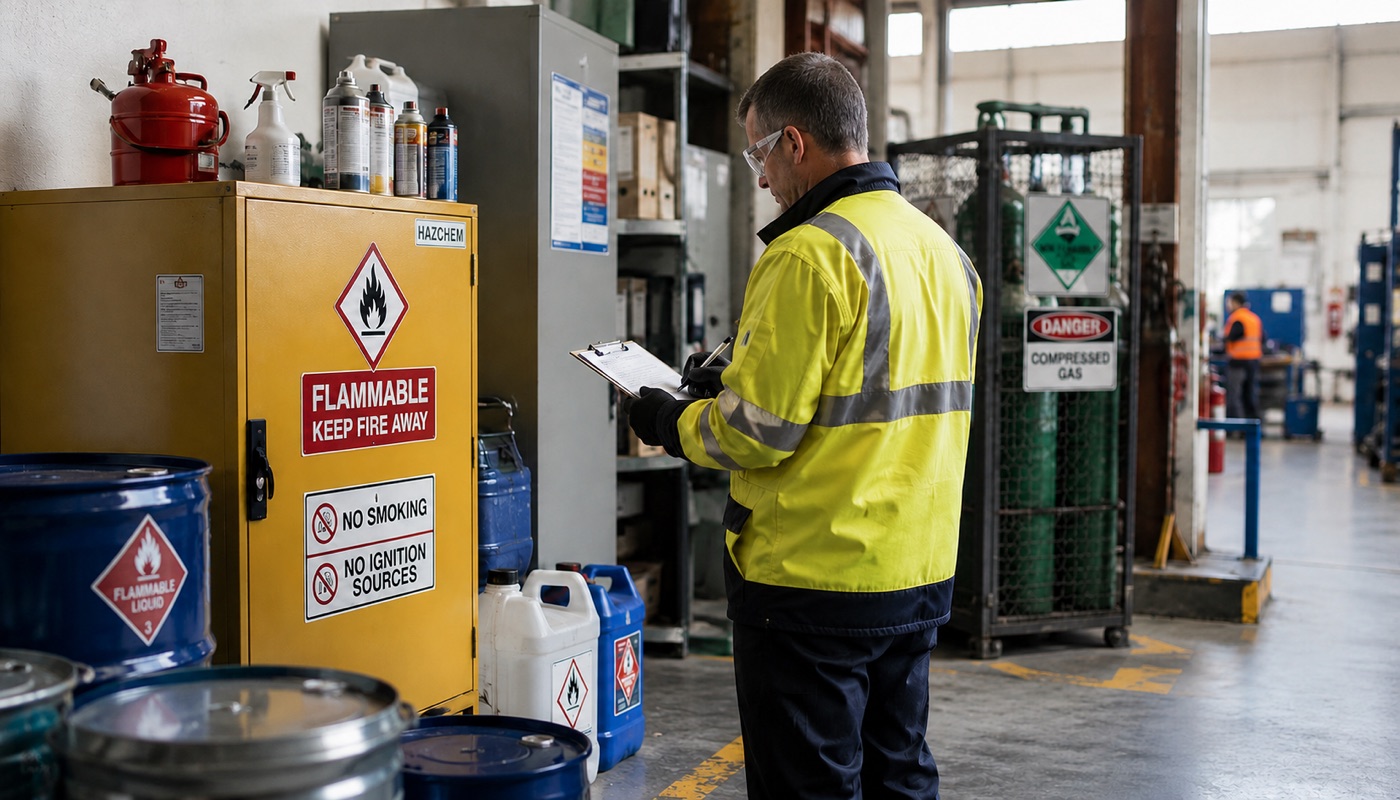
In Great Britain, the overarching law is the Health and Safety at Work etc. Act 1974, which sets the general duty to protect the health, safety and welfare of people at work. Specific regulations sit beneath it – from the broad requirements of the Management of Health and Safety at Work Regulations 1999 to targeted areas like the Dangerous Substances and Explosive Atmospheres Regulations 2002 (DSEAR), which require employers to control the risks from substances that can cause fire, explosion, or corrosion to metal, according to the Health and Safety Executive (HSE). If your workplace stores or uses flammable or combustible materials, DSEAR almost certainly applies – and you will usually need a DSEAR risk assessment alongside your fire risk assessment. This applies to employers, duty holders, and facilities managers across settings such as manufacturers, workshops, laboratories, warehouses, and retail businesses storing flammable goods.
Spray paint, wood dust, hand sanitiser. Seemingly harmless substances are classed as dangerous under UK health and safety law – but do your staff realise the risks? When incorrectly stored, managed, and used, everyday chemicals and dusts can become deadly ignition sources and a key cause of workplace fires and explosions.
Under UK safety regulations, substances are designated as dangerous if they could cause harm through a fire, an explosion, or metal corrosion. They include familiar flammables like liquid petroleum gas (LPG), solvents, and pressurised gases, alongside less obvious combustible materials, including dusts from machining, sanding, and food production.
In the workplace, these substances are controlled by the Dangerous Substances and Explosive Atmospheres Regulations 2002 (DSEAR). It's a critical but often misunderstood or overlooked branch of health and safety law that requires employers to control safety risks from fire, explosions, and corrosives. It implements the EU ATEX 'workplace' Directive (1999/92/EC) on protecting workers from explosive atmospheres, alongside the safety requirements of the Chemical Agents Directive.
Your duty of care under DSEAR includes regular risk assessments, action to train and inform staff, and responsible management of hazardous materials across your working environment. Current DSEAR regulations require every business to:
- Locate the dangerous substances in your workplace and the risks they pose.
- Put safety measures in place to either remove or control those risks.
- Implement controls to reduce the effects of any incidents involving dangerous substances.
- Prepare plans and procedures to deal with accidents, incidents, and emergencies involving dangerous substances.
- Give employees the information, instruction and training they need to control or deal with the risks from the dangerous substances.
- Identify and classify areas of the workplace where explosive atmospheres may occur and avoid ignition sources (from unprotected equipment, for example) in those areas.
This article uncovers hidden DSEAR hazards across your business, provides practical guidance to control them – and explains why a fire risk assessment isn't enough to keep you compliant. For a broader overview of the legal framework behind workplace safety duties, read our guide to what health and safety legislation is.
DSEAR and fire risk assessments – do you need both?
Very often, you do. Because DSEAR is so closely related to fire safety, many employers wrongly believe a separate DSEAR risk assessment isn't necessary. However, each risk assessment focuses on different hazards and is governed by different UK health and safety laws – a fire risk assessment sits under the Regulatory Reform (Fire Safety) Order 2005, while a DSEAR risk assessment sits under DSEAR 2002.
A fire risk assessment
- Focuses on general fire safety
- Is needed for almost all non-domestic buildings
- Aims to protect people from fire and enable safe evacuation
- Examines detection systems, escape routes, hazardous equipment, ignition sources, and emergency procedures
A DSEAR risk assessment
- Locates dangerous substances that could cause a fire, explosion, or metal corrosion
- Is only required if dangerous substances are onsite
- Looks to prevent and control explosive or flammable atmospheres
- Covers solvents, gases, vapours, fuel storage, ventilation, and explosive atmospheres and their likelihood
Your business needs both types of risk assessment if you use substances that could ignite, explode, fuel a fire, or create explosive vapours or dusts. If your operations involve fuels, solvents, paints, flammable gases, aerosols, combustible dusts, or explosive chemicals, you should consider conducting a DSEAR risk assessment.
Common DSEAR-related activities include:
- Storing petrol for cars, boats, or horticultural machinery.
- Handling and storing waste dusts for manufacturing, flammable fuel oils, or pressurised gases.
- Storing or displaying paints and other flammable goods in a retail setting.
- Carrying out welding or other 'hot work' on tanks and drums that have contained flammable material.
- Using flammable gases, such as acetylene, for welding.
- Using flammable solvents in a lab setting.
- Filling, storing, and handling aerosols with flammable propellants such as LPG.
- Transporting flammable substances in containers around a workplace.
- Receiving deliveries from road tankers, such as petrol and bulk powders.
If you're unsure whether your work falls under DSEAR requirements, get helpful guidance from an Opus Safety consultant. We can also use our expertise to decide if your risk under DSEAR is low and therefore any controls required can be incorporated directly into your fire risk assessment.
Locating and controlling your DSEAR risks
The first step to DSEAR compliance is understanding your risks. A comprehensive DSEAR risk assessment identifies and indexes dangerous substances across your site, gauging the harm they pose to people in the event of a fire, explosion, or similar event. You can carry out your DSEAR audit in combination with your fire risk assessment.
Your DSEAR risk assessment should include five key steps:
- Identify fire and explosion risks, as well as hazards from similar energetic events. Where are the ignition sources and work processes that could set dangerous substances alight or create an explosive atmosphere? And how serious would the resulting fire or explosion be?
- Decide who might be harmed and how. Who would be affected or hurt by the fire or explosion? Your controls should protect employees and members of the public who might be placed at risk by your work.
- Evaluate the risks and decide on precautions. How would you eliminate or reduce your risks, as far as is reasonably practicable? This might include swapping a dangerous substance for a less hazardous alternative or introducing control measures, such as increased ventilation, smarter storage solutions, spark-resistant tools, and gas detection systems.
- Record your findings and implement control measures. If you employ five or more people, you need to record the findings of your risk assessment. However, it's good practice to track outcomes in smaller businesses too. Include the location and extent of explosive atmospheres and the zone classification, based on their likelihood and persistence. Ask your Opus consultant for more information – and how safety management software can simplify the process.
- Review your risk assessment and update if necessary. Revisit your risk assessment following an incident, near miss, or significant change to your workplace. Have you introduced new dangerous substances or changed the quantity of existing ones? Would new equipment or working processes impact your DSEAR risks? Hazards often increase during non-core activities – such as maintenance, cleaning, contractor work, equipment downtime, or shift handovers – so be sure to include them in your risk assessment.
Start-to-finish DSEAR support
At Opus Safety, our in-depth DSEAR risk assessments catalogue every flammable liquid, gas, vapour, and combustible dust on site – creating an exhaustive list of what could ignite or explode and where.
From there, your experienced DSEAR specialist shapes a practical compliance management plan to minimise hazards and address knowledge gaps across your workforce. We help you:
- Detect potentially explosive atmospheres and eliminate ignition sources, mapping and illustrating every zone where explosive atmospheres could form.
- Support with Hazardous Area Classification, in line with DSEAR requirements.
- Prioritise fixes with a personalised follow-up report and action plan, ranked by risk level.
- Train staff to recognise hazards and work safely with dangerous substances.
- Adapt working practices to reduce DSEAR risks.
- Implement targeted control and mitigation measures, such as ventilation systems, fire safety equipment, and PPE.
- Implement a site-specific emergency response plan for substance-related incidents.
- Establish compliant reporting processes.
Opus's tailored services help you navigate the complexities of DSEAR compliance and actively protect your staff and site. Our competent DSEAR consultants are here to chat through your health and safety concerns or schedule your DSEAR risk assessment.
We're here to help on 0330 043 4015 or hello@opus-safety.co.uk.
Frequently asked questions
What is DSEAR? DSEAR is the Dangerous Substances and Explosive Atmospheres Regulations 2002. It requires employers to assess and control the risks from substances that could cause harm through fire, explosion, or corrosion to metal – from flammable liquids and gases to combustible dusts.
Do I need a DSEAR risk assessment? You need one if dangerous substances are, or may be, present at your workplace – for example fuels, solvents, paints, flammable gases, aerosols, combustible dusts, or explosive chemicals. If you store or use any of these, DSEAR almost certainly applies.
What is the difference between a fire risk assessment and a DSEAR risk assessment? A fire risk assessment covers general fire safety and is required for almost all non-domestic premises under the Regulatory Reform (Fire Safety) Order 2005. A DSEAR risk assessment is narrower – it is only required where dangerous substances are present, and it focuses on preventing and controlling fires, explosions, and explosive atmospheres. Many businesses need both.
What counts as a dangerous substance under DSEAR? Any substance that could cause harm through fire, explosion, or corrosion to metal. That includes solvents, paints, varnishes, flammable gases such as LPG, pressurised gases, and combustible dusts from machining, sanding, or food production.
Do small businesses need a DSEAR risk assessment? Yes – the duty to assess applies whatever your size. The difference is recording: if you employ five or more people, you must record the significant findings of your assessment. Smaller businesses still need to assess the risks, and it's good practice to record the outcomes too.

Last updated
July 27, 2026
Opus Safety
Health & safety insights
Guidance, updates and practical advice for your sector.




What is COSHH? What the regulations cover and what they require
COSHH stands for Control of Substances Hazardous to Health. What the 2002 Regulations cover, the nine hazard symbols and each duty in order.
COSHH assessment: what it is and how to do one properly
A COSHH assessment records the health risk from each hazardous substance you use, and the controls for it. What Regulation 6 requires, and the six steps.
Who Is Responsible for Health and Safety? Legionella Duties Explained
Who Is Responsible for Health and Safety? Legionella Duties Explained. Learn UK duty holder responsibilities and Legionella risk assessment duties.
Martyn's Law: Navigating the Terrorism (Protection of Premises) Act 2025
A practical guide to Martyn's Law - who it applies to, the standard and enhanced tiers, your core duties, and what businesses should do now to prepare.
Annual HSE statistics explained: Key takeaways and priorities for 2026
Get headline insights from the HSE’s health and safety at work figures for 2024/25 – alongside practical guidance for your 2026 compliance programme.

Why businesses choose
Opus Safety
We've worked across UK industry for years. The numbers show what our clients achieve when compliance becomes a strength, not a burden.


%201.svg)


