


- Health and safety signs come in five types: prohibition, warning, mandatory, emergency escape or first aid, and firefighting equipment.
- Schedule 1 to the Health and Safety (Safety Signs and Signals) Regulations 1996 fixes each shape and colour: a red circle with a diagonal bar prohibits, a yellow triangle warns of a hazard, a blue circle tells you what you must do, a green rectangle shows escape routes and first aid, and a red rectangle marks firefighting equipment.
- In England, Wales and Scotland, regulation 4 of the Health and Safety (Safety Signs and Signals) Regulations 1996 requires a sign where your risk assessment shows a risk that cannot be avoided or adequately reduced except by a sign. Northern Ireland has its own equivalent regulations from the same year.
- Fire exit and fire equipment signs are required by the fire safety law of each nation, and take the same shapes and colours.
- Hazard signs are the yellow warning triangles. The red-bordered diamonds on chemical labels are CLP hazard pictograms, a separate system.
Health and safety signs come in five types, and Schedule 1 to the Health and Safety (Safety Signs and Signals) Regulations 1996 fixes the shape and colour of each. A red circle with a diagonal bar prohibits, a yellow triangle warns of a hazard, a blue circle tells you what you must do, a green rectangle shows an escape route or first aid, and a red rectangle marks firefighting equipment. Employers in Great Britain must provide and maintain a sign wherever their risk assessment shows that a risk to employees cannot be avoided or adequately reduced except by a sign. They must also train employees in what the signs mean.
The five types of health and safety signs
The shapes and colours below come from Part II of Schedule 1 to the Health and Safety (Safety Signs and Signals) Regulations 1996. The percentage is the minimum share of the sign's area that the safety colour must cover.
| Type | Shape and colours | What it tells you | Examples listed in the Regulations |
|---|---|---|---|
| Prohibition | Round. Black pictogram on white, with red edging and a red diagonal line (red at least 35%) | Do not do this | No smoking, no access for pedestrians, do not extinguish with water |
| Warning | Triangle. Black pictogram on yellow, with black edging (yellow at least 50%) | Take care: there is a hazard here | Danger: electricity, overhead load, industrial vehicles, general danger |
| Mandatory | Round. White pictogram on blue (blue at least 50%) | You must do this | Eye protection must be worn, safety boots must be worn, pedestrians must use this route |
| Emergency escape or first aid | Rectangle or square. White pictogram on green (green at least 50%) | Where to go or what to use in an emergency | Emergency exit, first-aid post, eyewash, safety shower |
| Firefighting equipment | Rectangle or square. White pictogram on red (red at least 50%) | Where the firefighting equipment is | Fire extinguisher, fire hose, emergency fire telephone |
The colours keep the same meaning wherever they are used. Part I of the Schedule gives red to prohibition, danger alarms and firefighting equipment, yellow or amber to warnings, blue to mandatory action, and green to escape routes, first aid and "no danger".
Pictograms may differ slightly from the drawings in the Schedule, provided the meaning stays the same. HSE's guidance on the Regulations, L64, says the pictograms in BS EN ISO 7010 can be used to comply.
Prohibition signs
A prohibition sign forbids "behaviour likely to cause a risk to health or safety", in the Regulations' own words. Use one where the control is keeping people away from a place or an action, such as "No access for unauthorised persons" on a plant room door.
Warning signs, the hazard signs of the Regulations
Warning signs are the yellow triangles. The Schedule's list includes danger: electricity, overhead load, industrial vehicles, biological risk, low temperature and drop. Danger signs such as "Danger: electricity" belong to this category. The general danger sign, an exclamation mark in a triangle, covers a hazard with no pictogram of its own. L64 suggests adding text to a general danger sign so people know what the danger is.
Mandatory signs
A mandatory sign prescribes behaviour. Nine of the eleven mandatory signs in the Schedule concern protective equipment, such as eye protection and a safety harness. If you add text, L64 says it should keep the mandatory sense, using "must" and avoiding "should" or "may": "Face protection must be worn".
Emergency escape and first-aid signs
These green signs are also known as safe condition signs. The Regulations list emergency exit or escape route, first-aid post, stretcher, safety shower, eyewash and the emergency telephone for first aid or escape. A green "this way" arrow is a supplementary sign used with them.
Fire safety signs
The Regulations define a fire safety sign as one that gives information on escape routes and emergency exits, identifies or locates firefighting equipment, or warns in case of fire. Fire exit signs are green, because they mark an escape route, while fire extinguisher and fire hose signs are red. The definition also covers acoustic signals, so a fire alarm counts as a fire safety sign.
Are hazard signs the same as hazard pictograms?
No, they belong to two different systems. A hazard sign under the Safety Signs Regulations is a yellow warning triangle on a wall, a door or the edge of an area. A hazard pictogram is the red-bordered diamond printed on a chemical's label under the GB CLP Regulation. HSE lists nine of them, and our guide to COSHH and its hazard symbols sets out each one and what it warns of.
The two meet in Part III of the Schedule. Containers and visible pipes holding hazardous chemicals must carry the relevant CLP hazard pictograms, with pipe labels placed near the most dangerous points such as valves and joints. A room or area storing significant quantities of hazardous substances needs a warning sign near the store or on its door, unless the labels on the containers already do the job. Where the Schedule has no matching warning triangle, the CLP pictogram is used on the sign.
The general danger sign is allowed at a store holding a number of hazardous substances. The Schedule rules it out as a warning about any single hazardous substance.
When does the law require a safety sign?
Regulation 4 of the Health and Safety (Safety Signs and Signals) Regulations 1996 sets the test. A sign is required when the risk assessment under regulation 3 of the Management of Health and Safety at Work Regulations 1999 shows that the employer "cannot avoid or adequately reduce risks to employees except by the provision of appropriate safety signs". A risk counts as adequately reduced only when there is "no longer a significant risk of harm". Where the test is met, the employer must provide and maintain the sign in the form the Schedule sets out.
So a sign comes after the other controls. HSE's L64 is direct about it: "Safety signs are not a substitute for those other methods of control." On a builders merchant's yard, the layout and a team directing customers keep people away from moving forklift trucks. The industrial vehicles warning sign tells people about the risk that remains. If no significant risk remains, L64 says there may be no need for a sign at all. Every sign decision therefore starts from a clear view of what counts as a hazard on your site and what your controls leave behind.
Two other duties sit alongside the test. Where a traffic risk at work needs a sign and road traffic law prescribes one for that situation, regulation 4(6) of the Health and Safety (Safety Signs and Signals) Regulations 1996 requires that road sign, whether or not road traffic law applies to the site. Regulation 5 of the Health and Safety (Safety Signs and Signals) Regulations 1996 requires every employer to give employees "suitable and sufficient instruction and training in the meaning of safety signs and the measures to be taken in connection with safety signs". L64 points out that new, young or inexperienced employees may be unfamiliar with the less common signs.
The managers who write your risk assessments are the people deciding where signs go. Opus runs one-day risk assessment training at your premises, and the practical work uses your own risk assessment templates.
These Regulations apply in England, Wales and Scotland. Northern Ireland has its own equivalent, the Health and Safety (Safety Signs and Signals) Regulations (Northern Ireland) 1996, with the same five categories, shapes and colours.
Fire safety signs and fire safety law
The duty to put up fire exit and fire equipment signs comes from the fire safety law of each nation. Regulation 4(3) of the Health and Safety (Safety Signs and Signals) Regulations 1996 then applies the Schedule's formats to those signs, so they take the shapes and colours in the table above.
| Nation | Signs for emergency routes and exits | Signs for firefighting equipment | Who the duties fall on |
|---|---|---|---|
| England and Wales | Article 14(2)(g) of the Regulatory Reform (Fire Safety) Order 2005 | Article 13(1)(b) of the Regulatory Reform (Fire Safety) Order 2005 | The responsible person |
| Scotland | Regulation 13(2)(g) of the Fire Safety (Scotland) Regulations 2006 | Regulation 12(1)(b) of the Fire Safety (Scotland) Regulations 2006 | Anyone with duties under section 53 or 54 of the Fire (Scotland) Act 2005 |
| Northern Ireland | Regulation 13(2)(g) of the Fire Safety Regulations (Northern Ireland) 2010 | Regulation 12(1)(b) of the Fire Safety Regulations (Northern Ireland) 2010 | Anyone with duties under Article 25 or 26 of the Fire and Rescue Services (Northern Ireland) Order 2006 |
All three use near-identical words: emergency routes and exits are to be "indicated by signs", and non-automatic firefighting equipment is to be "easily accessible, simple to use and indicated by signs".
L64 adds the practical rules. Put the fire exit sign immediately above the exit, or where it can be seen clearly and is least likely to be hidden by smoke. Where stock or racking can block the view of an exit, as in a warehouse, add fire exit signs with directional arrows along the escape route. A sign carrying only the words "Fire exit" will not do: it needs the moving person pictogram, with any text alongside it. L64 also notes that extinguisher colour coding sits outside these Regulations, and our guide to fire extinguisher types and colours covers it.
Which fire signs you need, and where, should come out of your fire risk assessment. Opus carries out fire risk assessments for business premises to PAS 79, in England, Wales, Scotland and Northern Ireland.
Where should health and safety signs go, and how do you keep them working?
Schedule 1 to the Health and Safety (Safety Signs and Signals) Regulations 1996 also sets the rules for placing and keeping signs. These are the ones that come up on a real site.
| Topic | What the Schedule requires |
|---|---|
| Position | Fix signs "at a suitable height and in a position appropriate to the line of sight": at the access point to an area for a general hazard, or right beside a specific hazard. The Regulations set no fixed mounting height |
| Light | Put signs somewhere well lit. Where natural light is poor, use phosphorescent colours, reflective materials or artificial lighting |
| Number | Avoid placing too many signs close together. L64 warns that a cluster of signs risks confusion, or important information being overlooked |
| Upkeep | Clean, check, repair and replace signs so they keep working |
| Removal | Take a sign down once the situation it refers to has gone, so it stops giving misleading information |
| Power | A sign that needs power, such as an illuminated exit sign, must have an emergency supply that keeps it working through a power cut, unless the power cut itself removes the hazard |
| Impaired sight or hearing | Where workers' sight or hearing is impaired, including by the PPE they wear, supplement or replace the sign. Ear defenders in a noisy area can mask an alarm, so a flashing light alongside it can carry the warning |
| Floors and obstacles | Mark places where people could hit an obstacle, fall, or be struck by falling objects with yellow and black or red and white stripes at about 45 degrees. Where needed for safety, mark vehicle traffic routes indoors with continuous stripes, preferably white or yellow |
Missing, faded and out-of-date signs show up on a walk round the site. Opus's health and safety audits include a site inspection that checks whether what your risk assessments say is what happens on the premises. Opus's consultants include former health and safety inspectors.
Frequently asked questions
What are the 5 types of health and safety signs? Prohibition signs (red circle), warning signs (yellow triangle), mandatory signs (blue circle), emergency escape or first-aid signs (green rectangle) and firefighting equipment signs (red rectangle). Schedule 1 to the Health and Safety (Safety Signs and Signals) Regulations 1996 sets the shape and colour of each.
What are the four main safety signs? Prohibition, warning, mandatory and emergency escape or first aid, one for each of the four safety colours in HSE's L64 guidance: red, yellow, blue and green. Firefighting equipment signs, which are red rectangles, make a fifth type.
What colour are hazard signs? Yellow, with a black pictogram and a black border, in a triangle. The yellow must cover at least half of the sign. The red-bordered diamonds on chemical labels are CLP hazard pictograms, which are a different system.
What is a safe condition sign? A green sign showing an emergency exit, an escape route or first-aid equipment, such as a first-aid post or an eyewash station. The Regulations call these emergency escape or first-aid signs.
Are safety signs a legal requirement in the UK? Yes, where your risk assessment shows a risk that other controls cannot avoid or adequately reduce. In England, Wales and Scotland the duty is regulation 4 of the Health and Safety (Safety Signs and Signals) Regulations 1996, and Northern Ireland has its own equivalent regulations from the same year. Fire exit signs are required by the fire safety law of each nation.
Do safety signs need words on them? No. The pictogram carries the message, and text is optional. L64 says supplementary text can help with an unfamiliar sign or a general danger sign. A fire exit sign with text alone falls short, because it needs the pictogram.
What height should safety signs be? The Regulations give no fixed height. They require a suitable height and a position in the line of sight, at the entrance to an area for a general hazard or beside a specific hazard, in a well lit spot.
Who is responsible for safety signs at work? The employer. In a building shared by several occupiers, L64 says the owner normally handles signs in common areas such as stairways, and each occupier handles the signs inside its own part.

Last updated
November 12, 2026
Opus Safety
Health & safety insights
Guidance, updates and practical advice for your sector.
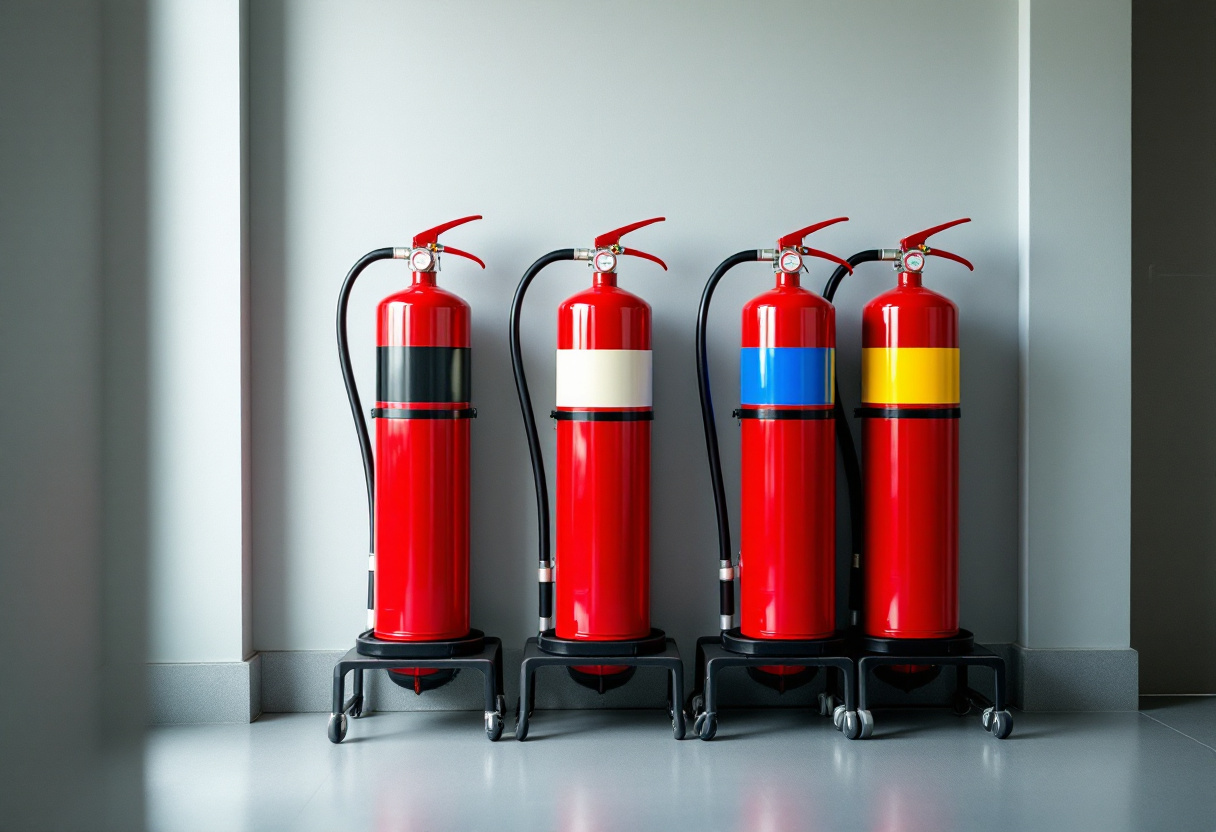




Fire extinguisher types and colours: what each one is for
Fire extinguisher types and colours in the UK: red water, cream foam, blue powder, black CO2, yellow wet chemical, and which fire each one is for.
PPE regulations and workplace welfare: what an employer must provide
Under the PPE regulations, employers in Great Britain must provide suitable PPE free of charge. Welfare law adds toilets, washing, water and rest areas.
What is COSHH? What the regulations cover and what they require
COSHH stands for Control of Substances Hazardous to Health. What the 2002 Regulations cover, the nine hazard symbols and each duty in order.
What health and safety actually requires of an employer
What is health and safety? In law it is a duty on you as the employer to assess risks, control them and prove it. What that means in practice, and when.
Forklift truck safety: Your back-to-basics guide
A rise in lift truck accidents means courts are cracking down on common compliance issues. Get a refresher on the fundamentals of forklift safety.
Fire risk assessments: Safety basics and best-practice guidance
Fire safety begins with a solid risk assessment. Get a rundown of FRA fundamentals and seven critical actions to protect your people and premises.

Why businesses choose
Opus Safety
We've worked across UK industry for years. The numbers show what our clients achieve when compliance becomes a strength, not a burden.


