

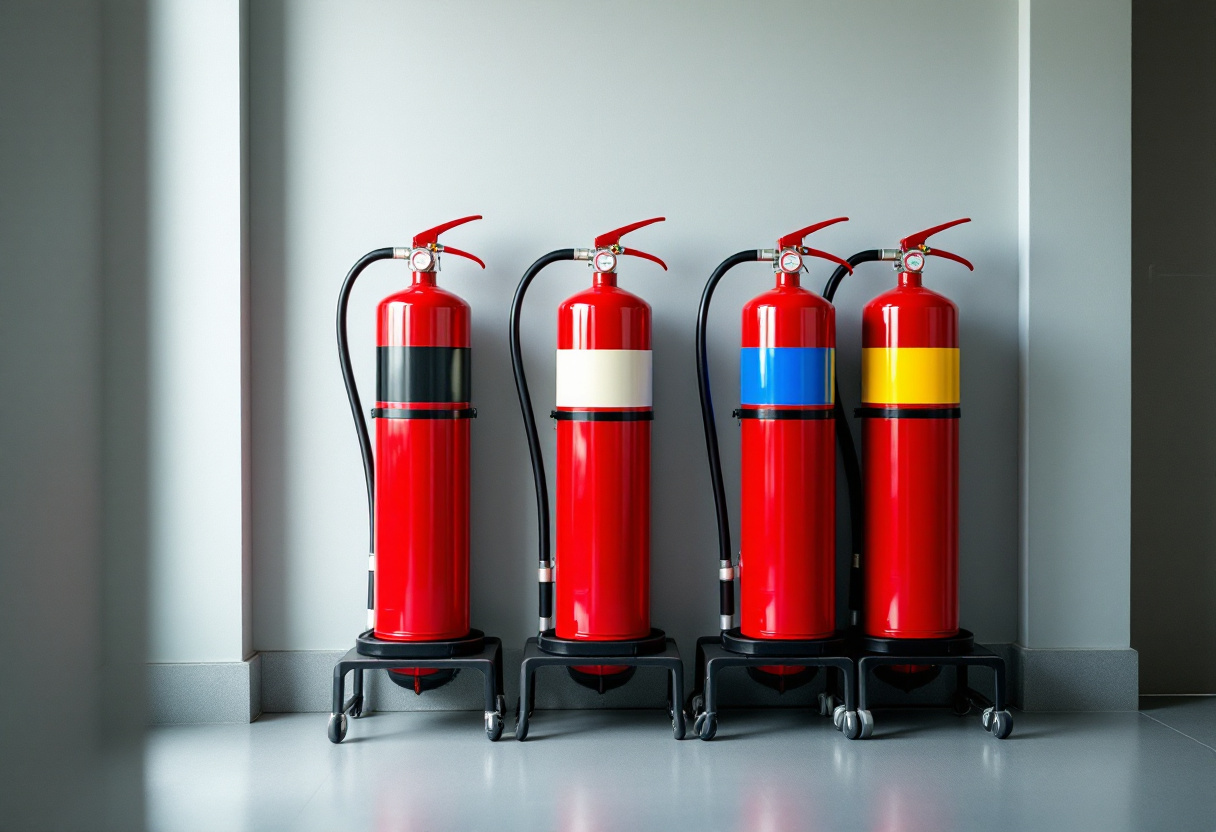
- There are five main types of fire extinguisher: water, foam, dry powder, carbon dioxide (CO2) and wet chemical.
- A new extinguisher has a signal red body, and a colour band shows the contents: red for water, cream for foam, blue for powder, black for CO2 and yellow for wet chemical.
- Choose by what is burning: Class A solids, Class B flammable liquids, Class C gases, Class D metals and Class F cooking oils, with electrical fires treated separately.
- On live electrical equipment, the code of practice for choosing extinguishers recommends CO2 or another non-conductive agent, with the power isolated first.
- In England and Wales, article 13 of the Regulatory Reform (Fire Safety) Order 2005 requires appropriate firefighting equipment, and Scotland and Northern Ireland have the same duty. Your fire risk assessment decides the type, number and position.
There are five main types of fire extinguisher in UK workplaces: water, foam, dry powder, carbon dioxide (CO2) and wet chemical. A new extinguisher has a signal red body, and a band of colour covering up to 5% of the body shows what is inside: red for water, cream for foam, blue for powder, black for CO2 and yellow for wet chemical. The colour tells you the contents. The rating on the label tells you which classes of fire it has been tested on. Choose by what is burning: water for wood and paper, foam for solids and flammable liquids, CO2 for electrical equipment, and wet chemical for a deep-fat fryer.
Fire extinguisher types and colours at a glance
The colours below follow London Fire Brigade's guidance note on portable firefighting equipment (GN08, January 2025). The uses follow the Home Office fire risk assessment guide for offices and shops and fire and rescue service guidance.
| Extinguisher | Colour band | Use on | Never use on |
|---|---|---|---|
| Water | Red, so the whole extinguisher is red | Class A: wood, paper, textiles and other solids | Flammable liquids, live electrical equipment, metals or cooking oil |
| Foam | Cream | Class A solids, and Class B flammable liquids such as petrol and diesel | Live electrical equipment, metals, deep-fat fryers or chip pans |
| Dry powder | Blue | Class A, B and C: solids, liquids and gases, plus electrical equipment up to 1,000 volts | Cooking oil, metals, or electrical equipment over 1,000 volts |
| Carbon dioxide (CO2) | Black | Live electrical equipment, and Class B flammable liquids | Metals. London Fire Brigade leaves CO2 off its Class A list, and a solid fire can reignite once the gas disperses |
| Wet chemical | Yellow | Class F: cooking oil and fat, such as a deep-fat fryer | Live electrical equipment: BS 5306-8 counts it as water-based |
| Class D powder | Signal violet | Class D: burning metals such as magnesium and titanium | Kept for flammable metal hazards only |
Two cautions sit outside the table. Powder knocks a fire down quickly but does little to cool it, so the fire can reignite. It also cuts visibility and can affect people with breathing problems, and the Home Office guide calls powder "not generally suitable for enclosed spaces". And the same guide says fires involving aerosols are unsafe to fight with any extinguisher.
What do the colours on a fire extinguisher mean?
The colour shows the extinguishing agent inside. New extinguishers should conform to BS EN 3 and are predominantly red. The UK colour coding sits in BS 5306-10:2019, the code of practice that replaced BS 7863 in 2019, which is why guides written before then, the Home Office's included, still cite BS 7863. London Fire Brigade puts the colour zone at a maximum of 5% of the body's surface area, and the Home Office guide places it above or within the operating instructions.
Other colours turn up at work too. Green marks clean agent extinguishers, and London Fire Brigade notes green coding on newer extinguishers sold for small lithium-ion battery fires. Water mist extinguishers have a white body, according to the same guidance. The special powder extinguisher for metal fires (Class D) carries signal violet, and it is a different extinguisher from the blue multi-purpose powder.
Some sites still have extinguishers painted entirely in one colour, such as a black CO2 or a cream foam. Those were made to earlier standards. The Home Office guide says they remain acceptable until they are no longer serviceable, and that it is good practice to keep old and new styles off the same floor. Some premises choose less conspicuous colours to match their branding, and London Fire Brigade says these may still carry the colour zone.
Read the rating as well as the colour, because the rating tells you what the extinguisher can put out. Ratings such as 13A, 34B and 15F are awarded after the fire tests in BS EN 3-7, and the letter is the class of fire. London Fire Brigade advises choosing by rating, ignoring size, weight and litres: a smaller extinguisher that meets 13A is as effective as a heavy 9-litre water extinguisher, and a 2.5 kg CO2 extinguisher is rated 34B.
Which fire extinguisher for each class of fire?
Fires are classed by what is burning, under BS EN 2. The Home Office guide lists five classes, and electrical fires are handled separately.
| Class of fire | What is burning | Extinguisher to use |
|---|---|---|
| Class A | Solids such as wood, paper and textiles | Water, foam or dry powder |
| Class B | Flammable liquids such as petrol, diesel and oils | Foam, CO2 or dry powder |
| Class C | Gases | Dry powder, after advice from a competent person |
| Class D | Metals | Special Class D powder or dry sand, after specialist advice |
| Class F | Cooking oils and fats, as in deep-fat fryers | Wet chemical |
| Electrical | Live electrical equipment | CO2, or another non-conductive agent |
BS EN 2 has no Class E. Fire and rescue service guidance, Surrey's for one, shows electrical fires as a sixth category alongside the five classes.
Where a Class C or Class D fire is possible on your site, the Home Office guide says to seek advice from a competent person. LPG cylinders on a builders merchant's yard and magnesium swarf in a machine shop are two examples.
Which fire extinguisher for electrical fires?
Use CO2. BS 5306-8, the code of practice for selecting and positioning portable extinguishers, says at clause 7.7.1 that "only electrically non-conductive extinguishing media, such as non-conductive powder, carbon dioxide or clean agent, should be used on live electrical equipment". It expects the equipment to be disconnected or isolated before any extinguisher is used on it, and warns that the supply to consumer units and fuse boards stays live except in a complete supply failure.
The Home Office guide says CO2 puts out an electrical fire without further damage, except to some electronic equipment such as computers. Powder works on electrical equipment but will almost certainly ruin it.
Water mist and some foam extinguishers are sold for electrical fires, and London Fire Brigade lists electrical fires among the uses of water mist. BS 5306-8 explains why water-based extinguishers may still be unsuitable near live equipment: purified water can become conductive again once it meets a fire. For a server room or a bank of battery chargers, ask your fire risk assessor which extinguisher your assessment calls for.
What does the law require you to provide?
The fire safety law in each nation requires appropriate firefighting equipment and leaves the type to you. Your fire risk assessment decides what is appropriate.
In England and Wales, article 13 of the Regulatory Reform (Fire Safety) Order 2005 requires the responsible person, where necessary, to ensure the premises are equipped with appropriate fire-fighting equipment, and that any non-automatic equipment is "easily accessible, simple to use and indicated by signs". Article 13(2) of the Order says what is appropriate depends on the dimensions and use of the premises, the equipment in them, the properties of the substances likely to be present and the maximum number of people present at any one time.
In Scotland, regulation 12 of the Fire Safety (Scotland) Regulations 2006 sets the same duty, in almost the same words, for employers and anyone with control of premises under sections 53 and 54 of the Fire (Scotland) Act 2005.
In Northern Ireland, regulation 12 of the Fire Safety Regulations (Northern Ireland) 2010 does the same for anyone with duties under Articles 25 or 26 of the Fire and Rescue Services (Northern Ireland) Order 2006.
Each regime also requires the equipment to be maintained "in efficient working order and in good repair": article 17 of the Regulatory Reform (Fire Safety) Order 2005, regulation 16 of the Fire Safety (Scotland) Regulations 2006 and regulation 16 of the Fire Safety Regulations (Northern Ireland) 2010.
How many extinguishers, and where?
In small premises, one or two extinguishers of the right type may be all you need. For Class A risks, the Home Office guide for offices and shops in England says one water-based extinguisher for about every 200 m² of floor space, with at least two per floor, will normally be adequate, and that ideally nobody should have to travel more than 30 m to reach one. Put general extinguishers on escape routes near the exits, and put specialist ones near the hazard they cover, such as CO2 by a server cabinet or wet chemical by the fryer.
Checks and servicing
The Home Office guide recommends a brief check every month in normal conditions, and maintenance by a competent person every year. London Fire Brigade lists what those user checks cover: each extinguisher in its place, instructions legible, no sign of use or damage, the gauge within limits, and seals and tamper indicators intact. It advises a basic service every year by a competent person, and extended servicing, which includes discharging and recharging, as set out in BS 5306-3. Keep a record of the maintenance.
Training the people who will use them
The Home Office guide puts it plainly: "People with no training should not be expected to attempt to extinguish a fire." All staff should know where the extinguishers are and how to operate them. Article 13(3) of the Regulatory Reform (Fire Safety) Order 2005 requires you, where necessary, to nominate competent persons and make sure their number, training and equipment are adequate.
Opus runs fire extinguisher training on your own site: a one-day course built around the extinguishers you actually have, after a review of your extinguisher inventory. Fire marshal and warden training adds the marshal role and evacuation, with practical use of water and CO2 extinguishers. For everyone else, fire awareness training covers fire classes and what to do when the alarm sounds.
The type, number and position of your extinguishers should come out of your fire risk assessment. Opus carries out fire risk assessments for business premises in England, Wales, Scotland and Northern Ireland, following PAS 79, and the service includes a maintenance programme covering alarms, lighting and extinguisher testing schedules. For what the assessment itself covers, read fire risk assessment basics.
Frequently asked questions
What are the 5 types of fire extinguisher? Water, foam, dry powder, carbon dioxide (CO2) and wet chemical. Specialist types such as Class D powder, water mist and clean agent extinguishers are used for particular risks.
What colour is a CO2 fire extinguisher? A red body with a black band. Older CO2 extinguishers may be black all over, and they remain acceptable until they are no longer serviceable.
What colour panel indicates a dry powder extinguisher? Blue. A special powder extinguisher for metal fires (Class D) carries a signal violet panel instead.
Which fire extinguisher should be used on electrical fires? CO2. BS 5306-8 recommends only non-conductive agents on live electrical equipment, such as CO2, non-conductive powder or clean agent, and expects the power to be isolated first.
What is a class F fire? A fire involving cooking oils or fats, such as a deep-fat fryer. Use a wet chemical extinguisher, which has a yellow band. Water and foam are unsuitable on cooking oil.
Is there a class E fire? No. BS EN 2 classifies fires as A, B, C, D and F. Electrical fires are treated separately, and some fire and rescue service guidance shows them as a sixth category.
How often should fire extinguishers be serviced? Every year, by a competent person, with a brief check every month in between. London Fire Brigade advises maintaining them as set out in BS 5306-3, the code of practice for commissioning and maintaining portable extinguishers.
What colour is a water mist fire extinguisher? White. London Fire Brigade's guidance says water mist extinguishers have a white body, unlike the signal red of the other types.

Last updated
November 6, 2026
Opus Safety
Health & safety insights
Guidance, updates and practical advice for your sector.


7 fire risk assessment companies for commercial premises in 2026
Seven fire risk assessment companies for commercial premises compared, who each one suits, and what to ask any assessor before you appoint them.
New fire safety regulations: a run-down of your responsibilities
On 1 October, the government introduced amendments to Section 156 of the Building Safety Act 2022. Learn what they mean for your fire safety strategy.
Fire risk assessments: Safety basics and best-practice guidance
Fire safety begins with a solid risk assessment. Get a rundown of FRA fundamentals and seven critical actions to protect your people and premises.

Why businesses choose
Opus Safety
We've worked across UK industry for years. The numbers show what our clients achieve when compliance becomes a strength, not a burden.


