%201.svg)
%201.svg)

COSHH stands for the Control of Substances Hazardous to Health Regulations 2002. They require employers in England, Wales and Scotland to assess the health risk from hazardous substances before the work starts, then prevent exposure or, where that is not reasonably practicable, control it adequately.
COSHH stands for the Control of Substances Hazardous to Health Regulations 2002. They require employers in England, Wales and Scotland to assess the health risk from hazardous substances before the work starts, then prevent exposure or, where that is not reasonably practicable, control it adequately. Northern Ireland has its own equivalent, the Northern Ireland COSHH Regulations of 2003 (SR 2003/34), built on the same structure.
This guide covers what COSHH means, what it reaches and what it leaves to other regulations, the duties in the order the law sets them, and the hazard symbols. It ends with what an assessment has to contain. For the method of writing one, substance by substance, our COSHH assessment guide picks up where this page stops.
Is COSHH a legal requirement?
Yes. COSHH is a statutory instrument, SI 2002/2677, in force since 21 November 2002 under regulation 1 of COSHH 2002. COSHH was made under section 15 of the Health and Safety at Work etc. Act 1974, and section 33(1)(c) of HSWA 1974 makes it an offence to contravene health and safety regulations made under that power.
The central duty is in regulation 6 of COSHH 2002: work liable to expose employees to a substance hazardous to health may only go ahead once the employer has made a suitable and sufficient assessment of the risk and put the steps it identifies in place.
Three HSE resources sit alongside the Regulations:
| Document | What it does |
|---|---|
| L5, the COSHH Approved Code of Practice and guidance | Practical advice on complying with the Regulations. The sixth edition was published in 2013 |
| EH40/2005 Workplace exposure limits | The list of workplace exposure limits (WELs) for Great Britain, which HSE describes as legally binding under COSHH. The edition on HSE's site was published in January 2020 |
| HSE's COSHH pages | Plain-English guidance, example assessments and COSHH essentials control sheets |
What substances does COSHH cover?
Regulation 2 of COSHH 2002 defines it in five parts. When people ask what the five main substances covered by COSHH are, these are the five.
| Part | A substance or mixture that | For example |
|---|---|---|
| (a) | Meets the criteria for any health hazard class under the CLP Regulation, whether or not it has been classified | A paint, adhesive or cleaner whose label carries a health hazard pictogram |
| (b) | Has a workplace exposure limit approved by HSE | Anything listed in EH40/2005 |
| (c) | Is a biological agent | Germs such as those causing leptospirosis or Legionnaires' disease |
| (d) | Is dust of any kind at or above 10 mg/m3 of inhalable dust, or 4 mg/m3 of respirable dust, as an 8-hour time-weighted average | General dust at those concentrations |
| (e) | Creates a risk to health because of its chemical or toxicological properties and the way it is used or present at work | Anything harmful the first four parts miss |
The definition reaches well past the products you buy. HSE's assessment guidance names substances the work itself produces: wood dust from sanding, silica dust from tile cutting and fumes from welding. None of those arrive with a safety data sheet. HSE's COSHH overview adds flour dust, solder fume, blood and waste to the list.
What sits outside COSHH, and why
Regulation 5 of COSHH 2002 switches off the main duties, regulations 6 to 13, in three situations:
- Where and to the extent that the Control of Lead at Work Regulations 2002 or the Control of Asbestos Regulations 2012 apply.
- Where a substance is hazardous to health solely because it is radioactive, explosive or flammable, or solely because it is at a high or low temperature or a high pressure.
- Where the risk is to a person receiving the substance in the course of medical or dental treatment.
HSE's list of what COSHH covers names lead, asbestos and radioactive substances as the three with their own specific regulations.
The word doing the work in the second exclusion is "solely". A solvent that is both flammable and harmful to breathe stays inside COSHH for its health effects. Its fire and explosion risk is assessed separately under the Dangerous Substances and Explosive Atmospheres Regulations 2002, which is the job of a DSEAR risk assessment. A site holding solvents, fuels or combustible dust may need both.
The COSHH regulations: the duties in order
The duties sit in regulations 6 to 13 of COSHH 2002, and they follow the order the work does.
| Regulation | What it requires |
|---|---|
| 6, assessment | Assess the risk before the work starts. Record the significant findings if you have five or more employees. Review it regularly, and straight away if it may no longer be valid or after a significant change in the work |
| 7, prevention or control | Prevent exposure, by substitution in preference. Where prevention is not reasonably practicable, control exposure adequately, using the measures in their order of priority |
| 8, use of controls | Take all reasonable steps to see controls are properly used. Employees must use them and report defects |
| 9, maintenance and testing | Keep controls in efficient working order and good repair. Thoroughly examine and test local exhaust ventilation (LEV). Thoroughly examine reusable respiratory protective equipment, and test it where appropriate |
| 10, monitoring | Measure exposure where the assessment shows it is needed to keep control adequate or protect health |
| 11, health surveillance | Put exposed employees under suitable health surveillance where it is appropriate |
| 12, information and training | Give suitable and sufficient information, instruction and training to employees liable to be exposed |
| 13, emergencies | Prepare procedures, information and warning systems for accidents, incidents and emergencies involving hazardous substances |
HSE's COSHH overview lists eight things an employer has to do, and they track the same sequence: find out the health hazards, decide how to prevent harm, provide control measures, make sure they are used, keep them in good working order, provide information and training, provide monitoring and health surveillance where appropriate, and plan for emergencies.
Four of those duties carry detail worth knowing before an assessment is written.
Control follows an order of priority. Regulation 7 of COSHH 2002 puts the design of work processes, systems and engineering controls first, then control at source, including adequate ventilation. Personal protective equipment comes last, only where adequate control cannot be achieved by other means, and in addition to the other measures.
Adequate has a legal meaning. Regulation 7(7) of COSHH 2002 treats control as adequate only if three conditions are all met: the principles of good practice set out below are applied, any WEL for the substance is kept to, and exposure to a carcinogen, mutagen or asthmagen is reduced as low as is reasonably practicable. A monitoring result within the WEL settles only the second of them.
The LEV test interval is fixed by law. Regulation 9 of COSHH 2002 requires a thorough examination and test of LEV at least once every 14 months, and more often for the processes in Schedule 4 of COSHH 2002, such as every month where blasting is used to clean metal castings. The records must be kept for at least five years.
Some records outlast the job. Under regulation 10 of COSHH 2002, monitoring records that represent the personal exposure of identifiable employees must be kept for at least 40 years. Health records under regulation 11 of COSHH 2002 carry the same 40-year minimum. Where health surveillance is the gap, our health surveillance medicals are built from your COSHH assessments.
The duties also reach past your own staff. Regulation 3 of COSHH 2002 extends them, so far as is reasonably practicable, to anyone affected by your work, such as contractors and visitors. There are two exceptions. Health surveillance stays limited to your employees, and the monitoring, information, training and emergency duties reach other people only while they are on the premises where the work is done.
Are there three rules or five principles of COSHH?
Neither phrase appears in COSHH 2002. What the law does set out is eight principles of good practice, in Schedule 2A to the Control of Substances Hazardous to Health Regulations 2002, and regulation 7(7) of COSHH 2002 makes applying them one of the conditions of adequate control:
- Design and operate processes and activities to minimise the emission, release and spread of substances hazardous to health.
- Take into account all relevant routes of exposure (inhalation, skin absorption and ingestion) when developing control measures.
- Control exposure by measures that are proportionate to the health risk.
- Choose the most effective and reliable control options, the ones which minimise escape and spread.
- Where adequate control cannot be achieved by other means, provide suitable personal protective equipment in combination with other measures.
- Check and review all elements of control measures regularly for their continuing effectiveness.
- Inform and train all employees on the hazards and risks of the substances they work with and on the use of the control measures.
- Make sure that introducing a control measure leaves the overall risk to health and safety no higher than before.
If a training slide gives you three rules or five principles, check it against this list. The eight are the version in law.
COSHH symbols: the nine hazard pictograms
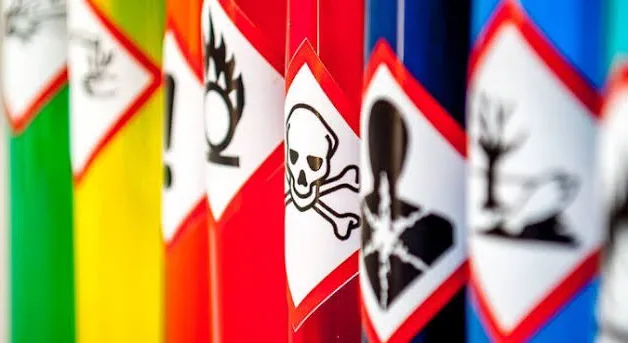
HSE lists nine GB CLP hazard pictograms, each a diamond with a red border and a white background. They come from Annex V of the GB CLP Regulation, the version of Regulation (EC) No 1272/2008 assimilated into GB law, which groups them by the type of hazard they mark.
| Symbol | What it warns of | Hazard type in Annex V |
|---|---|---|
| Exploding bomb | Explosive | Physical |
| Flame | Flammable | Physical |
| Flame over circle | Oxidising | Physical |
| Gas cylinder | Gas under pressure | Physical |
| Corrosion | Corrosive to metals, skin corrosion or serious eye damage | Physical and health |
| Skull and crossbones | Acute toxicity | Health |
| Exclamation mark | Irritation of the skin, eyes or airways, skin sensitisation, narcotic effects, category 4 acute toxicity, or harm to the ozone layer | Health, and ozone layer |
| Health hazard | Serious health hazard, such as respiratory sensitisation, carcinogenicity or mutagenicity | Health |
| Environment | Hazardous to the aquatic environment | Environmental |
The health hazard symbols are the ones that point to COSHH: corrosion, skull and crossbones, exclamation mark and health hazard. A product labelled with one of them for a health effect meets a health hazard class, which is part (a) of the definition in regulation 2 of COSHH 2002. The physical hazard symbols mark fire, explosion and pressure hazards, and the fire and explosion risk is assessed under DSEAR.
One product can carry both kinds of symbol and fall under both sets of regulations. An unlabelled substance can also be within COSHH: process dust, fume and biological agents carry no label, and part (a) applies whether or not a substance has been classified.
What a compliant assessment must contain
At summary level, the law sets the content. Regulation 6(2) of COSHH 2002 lists what the risk assessment must consider:
- the hazardous properties of each substance, and the supplier's information on health effects, including any safety data sheet
- the level, type and duration of exposure, and the circumstances of the work, including the amount of substance involved
- activities such as maintenance where exposure can be high
- any WEL or similar occupational exposure limit
- what the controls already taken or planned achieve
- results from health surveillance and exposure monitoring
- combined risk, where people are exposed to more than one substance
- the approved classification of any biological agent
- anything else needed to complete it
Under regulation 6(4) of COSHH 2002, an employer with five or more employees must record the significant findings as soon as practicable, and the steps taken to prevent or control exposure. HSE's COSHH FAQ confirms that no particular form is required. Regulation 6(3) of COSHH 2002 then requires a regular review, and an immediate one where there is reason to suspect the assessment is no longer valid, where there has been a significant change in the work, or where monitoring results show it is needed.
HSE's COSHH FAQ says the person doing it needs no particular qualification but must be competent. Where the work is small in scale with obvious controls, HSE's brief guide to COSHH says you can do the assessment yourself. Our COSHH assessment training is a one-day course, run at your premises, in which supervisors and managers write assessments from your own safety data sheets.
Where to start
Make two lists: what you buy, and what your processes make. The second list is the one that carries the dust and fume. Then check each entry against the five parts of the definition in regulation 2 of COSHH 2002.
Our consultants include former HSE and local authority regulators. If you want an outside view of where you stand, our COSHH risk assessment service assesses each substance as it is used on your site and sets out the controls, monitoring and health surveillance that follow from it.
Frequently asked questions
What does COSHH stand for? Control of Substances Hazardous to Health. It refers to the Control of Substances Hazardous to Health Regulations 2002, which apply in England, Wales and Scotland.
Is COSHH a legal requirement? Yes. COSHH 2002 is a statutory instrument, and contravening health and safety regulations is an offence under section 33(1)(c) of the Health and Safety at Work etc. Act 1974.
What are the 5 main substances covered by COSHH? Regulation 2 of COSHH 2002 defines five categories: substances meeting a CLP health hazard class, substances with a workplace exposure limit, biological agents, dust at or above set concentrations in air, and anything else whose properties and use at work create a risk to health.
What are the three basic rules of COSHH? The Regulations contain no three rules. The nearest thing in law is the order of the duties in regulations 6 to 13 of COSHH 2002: assess, prevent or adequately control, then use, maintain, monitor, provide health surveillance, train and prepare for emergencies.
What are the five principles of COSHH? The law sets out eight. Schedule 2A to the Control of Substances Hazardous to Health Regulations 2002 lists eight principles of good practice for controlling exposure, and applying them is a condition of adequate control under regulation 7(7) of COSHH 2002.
How many COSHH symbols are there? Nine. HSE lists nine GB CLP hazard pictograms. Corrosion, skull and crossbones, exclamation mark and health hazard are the ones that mark a health hazard.
When did COSHH come into force? The current Regulations came into force on 21 November 2002, under regulation 1 of COSHH 2002.
Does COSHH cover asbestos and lead? Mostly not. Regulation 5 of COSHH 2002 switches off the main duties, regulations 6 to 13, where and to the extent that the Control of Lead at Work Regulations 2002 or the Control of Asbestos Regulations 2012 apply, and both have their own requirements.

Last updated
October 6, 2026
Opus Safety
Health & safety insights
Guidance, updates and practical advice for your sector.




COSHH assessment: what it is and how to do one properly
A COSHH assessment records the health risk from each hazardous substance you use, and the controls for it. What Regulation 6 requires, and the six steps.
What Law Regulates Workplace Health and Safety? DSEAR Explained
What law regulates workplace health and safety? A clear guide to the HSWA, DSEAR and whether your business needs a DSEAR risk assessment.
Wood dust monitoring and health surveillance: Best practice for builders merchants
Wood dust is a known cause of health issues, from dermatitis to lung cancer. Protect your workers with proactive monitoring and surveillance measures.
Wood dust exposure: Are your controls working hard enough?
October is National Healthy Lung Month, so step up protection against harmful wood dust with safety solutions that go beyond local exhaust ventilation and PPE.
Safe chemical handling and storage: Your go-to guide
Understand your responsibilities under COSHH regulations with our quick guide to chemical compliance.
Dust exposure: How to protect your workers’ lung health
Inhaling sawdust, concrete dust, and other debris can lead to serious long-term health problems. Get expert guidance on proven safety controls.

Why businesses choose
Opus Safety
We've worked across UK industry for years. The numbers show what our clients achieve when compliance becomes a strength, not a burden.


%201.svg)


