%201.svg)
%201.svg)

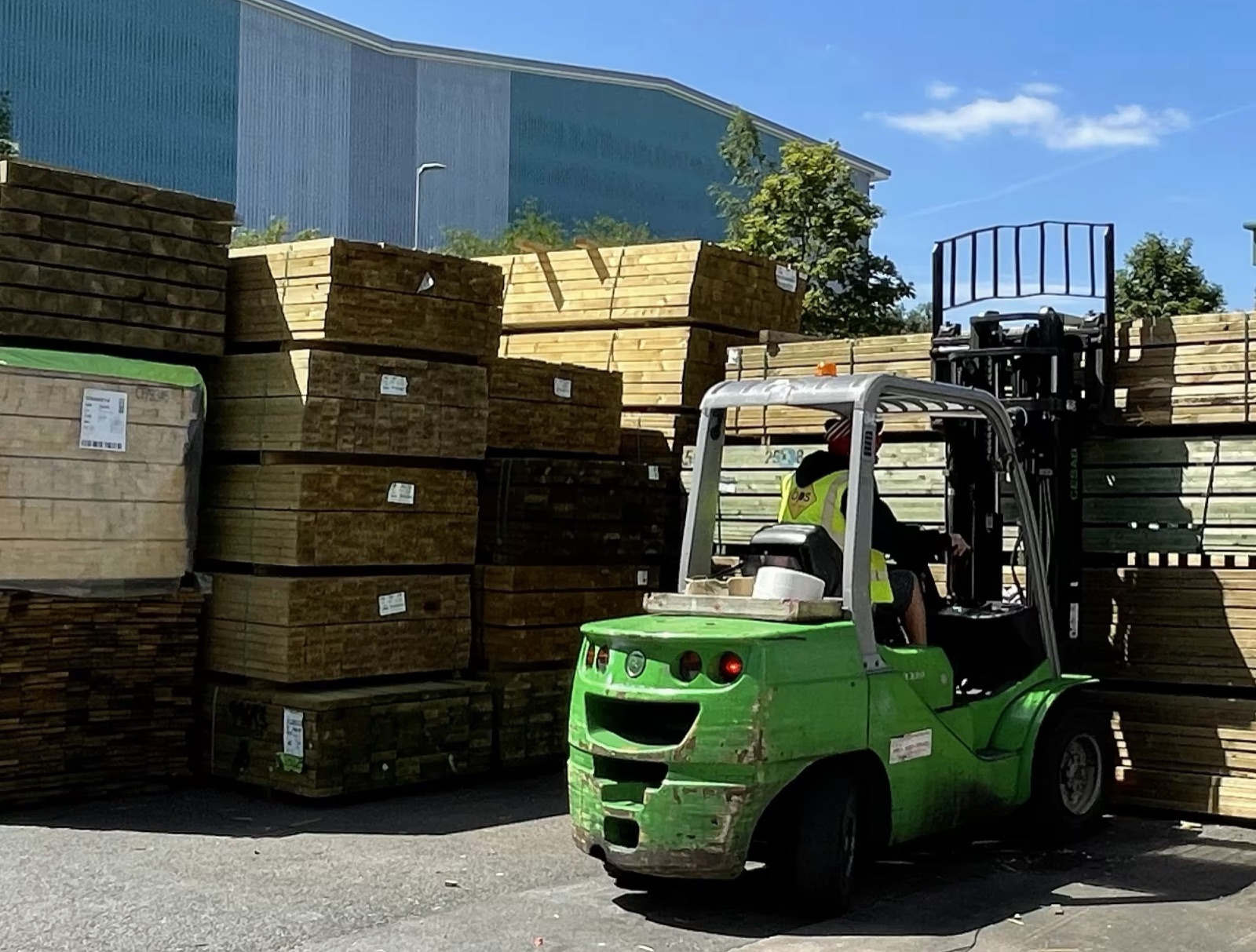
The hazards that make inspectors focus on merchants are the yard ones: vehicle movements, forklift operations and stacked materials.
The hazards that make inspectors focus on merchants are the yard ones: vehicle movements, forklift operations and stacked materials. All three sit outside what a generic, office-led assessment covers well, and all three can kill. The other six below turn up in enforcement because nobody took ownership of them, and each one is straightforward to control once somebody does. Work at height, fourth below, can also kill.
Why a merchant is not a warehouse
Merchanting combines three things that rarely appear together: a working yard with heavy vehicle movements, a retail counter with members of the public walking through, and a stock profile that runs from cement and timber to gas cylinders and powered tools.
An assessment written for a distribution centre misses the customer. One written for a shop misses the yard. The list below is ordered by potential severity, so frequent injuries, such as slips and handling strains, sit lower than they would on an incident log.
1. Vehicle movements in the yard
Deliveries arrive on artics, customers reverse into loading areas, and forklifts cross both. Putting pedestrians into that mix is where the severe outcomes come from, and separating them is the hardest thing to retrofit once a yard is laid out.
Regulation 17 of the Workplace (Health, Safety and Welfare) Regulations 1992 requires every workplace to be organised so that pedestrians and vehicles can circulate safely. In practice that means marked and physically separated walkways, a one-way flow where the yard allows it, and a reversing policy that does not rely on a colleague waving.
The layout also needs crossings where walkways meet a vehicle route, a pedestrian gate beside each vehicle entrance so nobody walks through the gateway, speed limits with signs and humps, seatbelts worn in every vehicle, and a marked loading zone with a safe place for visiting drivers to wait.
The fix that holds: physical segregation, with barriers wherever paint alone would be walked across, and control of the customer. A member of the public walking to their car with a length of timber across your yard is at risk unless someone shows them the correct route.
2. Forklift and telehandler operations
Every merchant runs lift trucks, and the failures cluster in three places: the truck itself, the operator, and the load.
Regulation 9 of the Lifting Operations and Lifting Equipment Regulations 1998 requires thorough examination of lifting equipment exposed to conditions that cause deterioration: at least every 12 months, at least every 6 months for equipment that lifts people and for lifting accessories, or at the intervals in a written examination scheme. That is separate from and additional to servicing. Regulation 5 of the Provision and Use of Work Equipment Regulations 1998 requires work equipment to be "maintained in an efficient state, in efficient working order and in good repair", and that where machinery has a maintenance log, the log is kept up to date. Operators need to be suitably trained, and that training refreshed at appropriate intervals.
The fix that holds: treat the thorough examination report as your own compliance document, even when the hire company arranged it. Run a planned maintenance regime for the trucks, and check that refresher training actually happened.
3. Racking, stillages and stacked materials
Timber stacks, block packs and racking that has been reconfigured over years without anyone recalculating the load can make your set-up vulnerable. Where impact damage from forklifts is routine and often unreported, that is what turns a dented upright into a collapse.
Racking is work equipment, so regulation 5 of the Provision and Use of Work Equipment Regulations 1998 applies to it in the same way it applies to trucks.
Stock falls as well as racking. Heavier items belong on the lower levels, loose lengths such as pipe and timber need restraining when they are stored at height, and the area below a load being placed or picked should be clear of people until the truck has finished.
The fix that holds: a named person doing a recorded visual inspection on a set frequency, plus a no-blame route for reporting a strike. Drivers who expect a disciplinary do not report the knock, and the damage stays invisible until a frame fails.
4. Work at height when picking, loading and fitting displays
Replenishing high bays, climbing onto a lorry bed to unload or sheet a load, and fitting seasonal displays all put people at height, often for a few minutes at a time. Short, routine jobs are the easiest ones to leave unplanned.
The order to work through comes from Regulation 6 of the Work at Height Regulations 2005. Avoid work at height where it is reasonably practicable to do the job safely another way. Where it cannot be avoided, prevent a fall by working from an existing safe place or with suitable equipment. Where a risk of falling remains, minimise the distance and the consequences.
The fix that holds: keep stock and displays reachable from the ground where you can, and provide purpose-built mobile steps, podium steps or access platforms for the rest, so nobody stands on a chair or climbs the racking itself. Nobody rides on the forks or stands on a pallet raised by a truck. Staff who do work at height need training for the equipment they use.
5. Members of the public on a working site
This is the hazard that separates merchants from other industrial settings. Customers walk through an operational yard, often in trainers, sometimes with children, and they do not know your rules.
Section 3 of the Health and Safety at Work etc. Act 1974 puts a duty on you to conduct your undertaking so that people who are not your employees are not exposed to risks to their health or safety, so far as is reasonably practicable. That duty is as enforceable as the one you owe your staff.
The fix that holds: a customer route that stays clear of the forklift route, signage people actually read, and an active team who direct customers and help keep them safe by pointing them to the correct places to be. Most merchants have the first two, but the third requires discipline to introduce and maintain.
6. Wood dust and other hazardous substances
Timber cutting is a service that plenty of merchants offer and few assess properly. Hardwood dust is a carcinogen, both hardwood and softwood dust can cause asthma, and both have workplace exposure limits.
Regulation 7 of the Control of Substances Hazardous to Health Regulations 2002 requires exposure to be prevented, or where that is not reasonably practicable, adequately controlled. Control means extraction at source, with respiratory protection kept as the last resort. Regulation 9 of the same Regulations then requires local exhaust ventilation to be thoroughly examined and tested at least once every 14 months, with the record kept for at least five years.
The same Regulations cover the products on your shelves: cement, adhesives, sealants, solvents and cleaning chemicals. Store each one as its safety data sheet directs, keep incompatible products apart, and keep only what you need on the shop floor.
The fix that holds: local exhaust ventilation on the saw, tested on schedule, and health surveillance for the people using it. A COSHH assessment that names the dust from your own cutting, alongside the chemicals you buy in, is the starting point.
7. Noise and vibration from cutting and tools
Saw noise can take merchant staff over the lower exposure action value without anyone knowing it, because noise feels like part of the job. Regulation 4 of the Control of Noise at Work Regulations 2005 sets that value at a daily or weekly personal noise exposure of 80 dB(A), or a peak sound pressure of 135 dB(C).
Regulation 5 of the same Regulations requires an assessment where employees are liable to be exposed at or above that level. Handing out ear defenders is not the assessment and does not replace it.
Power tools add hand-arm vibration. Regulation 4 of the Control of Vibration at Work Regulations 2005 sets a daily exposure action value of 2.5 m/s² A(8) and a daily exposure limit value of 5 m/s² A(8). Choosing the lowest-vibration tool that can do the job reduces exposure. Gloves keep hands warm but should not be relied on to protect against vibration (HSE). Daily exposure can be worked out from the tools in use and the time spent on the trigger. Our free HAVS calculator does that maths for each tool your team uses.
The fix that holds: measure the noise where the level is in doubt, because the duty and the controls both turn on the exposure level. A noise assessment settles the question either way.
8. Manual handling at the counter and in the yard
Cement, plasterboard, paving and timber are heavy, awkward and often handled in poor weather on uneven ground.
The duty sits in Regulation 4 of the Manual Handling Operations Regulations 1992: avoid hazardous manual handling so far as is reasonably practicable, assess what cannot be avoided, and reduce the risk. Schedule 1 to the Manual Handling Operations Regulations 1992 lists what the assessment has to look at, including the task, the load, the working environment and the individual doing it.
The fix that holds: mechanical aids close to where the lifting happens, loads broken down where the product allows it, and a policy on what staff will and will not load into a customer's car. The manual handling assessment is the documented part; the layout change is what reduces the injuries.
9. Slips and trips on the shop floor and in the yard
Loose banding and shrink-wrap from opened stock, wet entrances, uneven yard surfaces and stock pushed into walkways. Each is a small thing, and together they produce a steady run of injuries.
Regulation 12 of the Workplace (Health, Safety and Welfare) Regulations 1992 requires floors and traffic routes to be suitable for their use, free of holes, slopes and uneven or slippery surfaces that expose people to risk, and kept free, so far as is reasonably practicable, of anything that may cause a person to slip, trip or fall.
The fix that holds: a clean-as-you-go habit, with bins where stock is opened so banding and wrapping go straight in. Barrier matting at each entrance, fitted flush with the floor. A gritting plan for the yard before the first frost. Changes of level marked, and a lighting check after dark, when shadows can hide trip hazards. Staff can take slips, trips and falls training to spot the hazards on their own site.
Where to start if you are reviewing all nine
The order below runs by severity.
| Priority | Check | Why first |
|---|---|---|
| 1 | Pedestrian and vehicle segregation in the yard | Highest potential severity, and the hardest to retrofit |
| 2 | Lift truck thorough examination dates and operator refreshers | Legal duty with a fixed interval, easy to evidence, easy to miss |
| 3 | Racking damage reporting route | The damage stays hidden until a frame fails |
| 4 | Access equipment for high bays and lorry beds | Falls from height can kill, and short jobs are the ones left unplanned |
| 5 | Customer routes and loading policy | The duty in section 3 of HSWA 1974, usually the least documented |
| 6 | LEV test date on the saw | Carcinogen exposure with a 14-month testing interval |
| 7 | Noise measurement and vibration exposure | Cheap to settle, and the calculation for vibration needs no equipment |
| 8 | Manual handling | Frequent injuries, lower severity |
| 9 | Housekeeping, matting, gritting and lighting | Frequent injuries, lower severity, and the cheapest to fix |
Two of these carry fixed intervals that take minutes to check: the thorough examination under LOLER and the LEV testing under COSHH. Have those in order before anything else.
This article focuses on in-branch hazards. Your delivery fleet is the other half of the risk, including loading and unloading stock at the customer's site.
Frequently asked questions
What are the main health and safety risks in a builders merchant? Vehicle and pedestrian movements in the yard, forklift operations, stacked or racked materials and work at height carry the most serious outcomes. Manual handling and slips and trips produce the most frequent injuries: across all industries, they are the two most common kinds of non-fatal injury to employees in HSE's figures for 2024/25. The occupational health exposures to assess are wood dust from a cutting service, noise and vibration.
How often does a forklift need a thorough examination? At least every 12 months under regulation 9 of the Lifting Operations and Lifting Equipment Regulations 1998, unless a written examination scheme sets the intervals. A truck used to lift people, and any lifting accessory, needs one at least every 6 months, under the same exception. Servicing does not count as the thorough examination.
How often should racking be inspected in a builders merchant? HSE's warehousing guidance, HSG76, sets out a recorded visual inspection weekly or at other regular intervals based on risk assessment, an expert inspection by a technically competent person at intervals of not more than 12 months, and an immediate report whenever a truck strikes a frame. Racking is also work equipment under the Provision and Use of Work Equipment Regulations 1998, which requires it to be maintained in an efficient state and in good repair.
Do we need health surveillance for staff using the saw? Yes, on HSE's guidance. Breathing in wood dust can cause asthma, and HSE says health surveillance should cover every worker who might breathe it in, with a lighter programme of an annual questionnaire and a health record where exposure is adequately controlled and earlier checks show no problems. Your COSHH assessment has to name the dust your own cutting creates, as well as the products you buy in.
Does health and safety law cover customers in the yard? Yes. Section 3 of the Health and Safety at Work etc. Act 1974 requires you to conduct your undertaking so that people who are not your employees are not exposed to risks, so far as is reasonably practicable. A customer injured in your yard can become an enforcement matter.
Who is responsible for health and safety in a multi-site merchant? The employer, and in practice the directors who decide how it is resourced. Appointing a competent person, internally or externally, changes who does the work. The duty remains with the employer. We have written on what to do when there is no in-house expert.
Is a generic health and safety assessment enough for a merchant? Rarely. A merchant combines a working yard, a retail counter and a hazardous stock profile, and assessments written for a warehouse or a shop miss one of those. The gap is usually the customer and the cutting service.
If you want this checked properly
We work with merchants across the UK and are a BMF Preferred Supplier. Tell us how many branches you run and what is already in place, and we will tell you which of the nine above is your real exposure. See what we do for builders merchants, or the Opus Safety Partnership for ongoing cover. If you are weighing that against hiring somebody in, start with outsourced health and safety.

Last updated
February 11, 2025
Opus Safety
Health & safety insights
Guidance, updates and practical advice for your sector.







Work at Height Regulations 2005: what the law requires
The Work at Height Regulations 2005 apply in Great Britain at any height. The regulation 6 hierarchy, ladders, inspection intervals and who has duties.
LOLER regulations: lifting equipment duties explained
LOLER stands for the Lifting Operations and Lifting Equipment Regulations 1998. What the LOLER regulations cover, inspection intervals and who examines.
What is a hazard? Meaning, types and how to identify hazards at work
A hazard is anything that could cause injury or illness at work. What the word means, how it differs from risk, the main types and how to find them.
Manual Handling Operations Regulations 1992: duties, assessment and TILE
The Manual Handling Operations Regulations 1992: avoid, assess and reduce hazardous handling. What TILE stands for, and whether a weight limit exists.
Workplace Noise Assessments: Protecting Your Employees
What a noise risk assessment involves and what the Control of Noise at Work Regulations 2005 require of employers in Great Britain.
Wood dust exposure: Are your controls working hard enough?
October is National Healthy Lung Month, so step up protection against harmful wood dust with safety solutions that go beyond local exhaust ventilation and PPE.
Strategic HR Solutions: Unveiling the Untapped Benefits of Outsourcing HR
Discover the strategic advantages of outsourcing your HR. Save costs, access timely support, and tap into impartial advice and HR support.
Stack smart: Preventing accidents through better storage practices
Is your storage system a safety risk? Read expert advice on stacking best practice – and protect your business from a string of common compliance issues.
Safe manual handling: Best practices for builders merchant staff
Everyday lifting and shifting tasks put workers at risk of injuries & long-term musculoskeletal disorders. Protect your team with targeted safety tips
RIDDOR: Simple answers to your top six questions
Reporting under RIDDOR can be complex and confusing. We unpack common pitfalls and share a free white paper explaining when to report – and when not to.

Why businesses choose
Opus Safety
We've worked across UK industry for years. The numbers show what our clients achieve when compliance becomes a strength, not a burden.


%201.svg)


