%201.svg)
%201.svg)
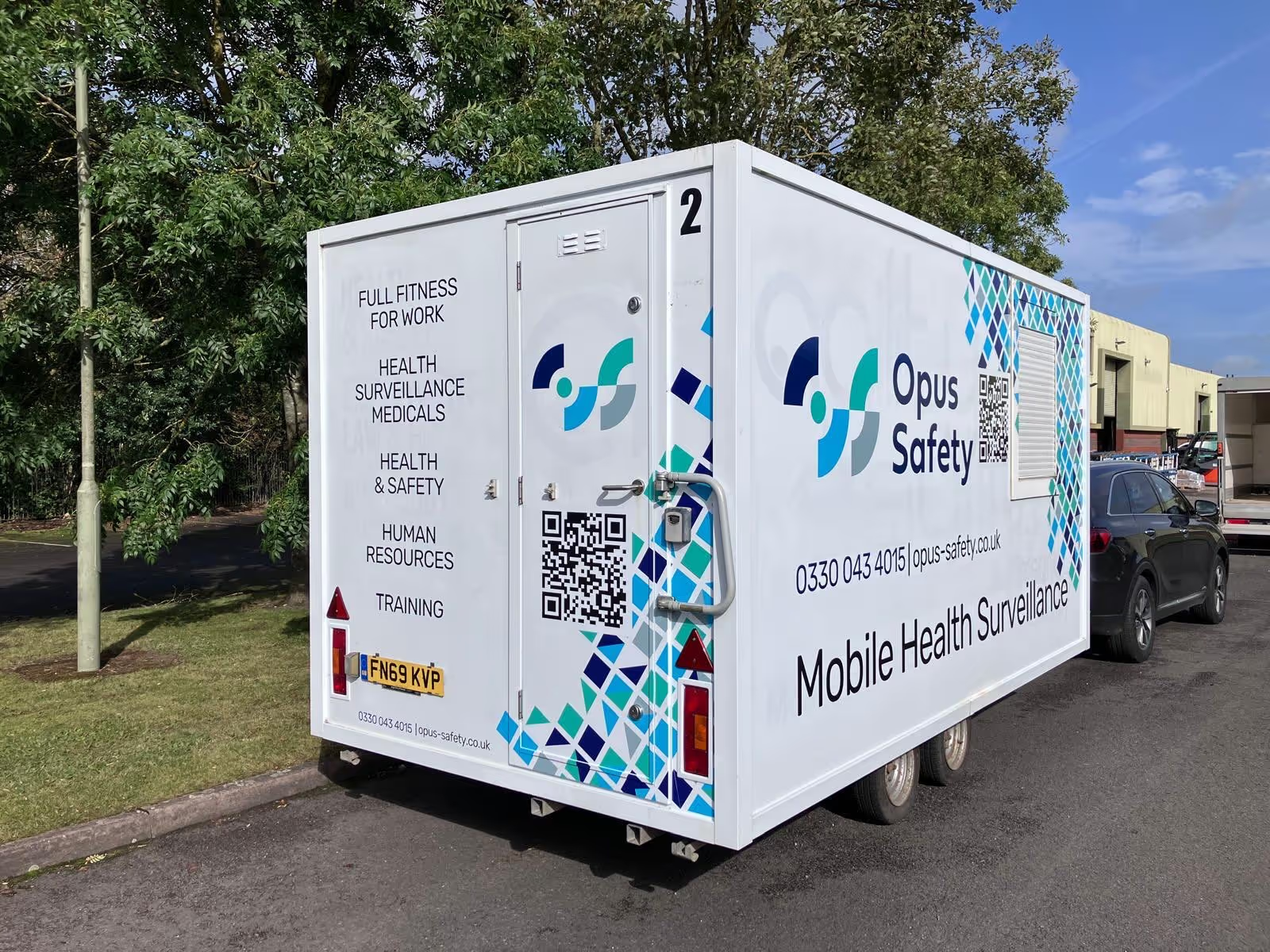
Face fit testing on your site, in the masks your team wears
A face fit test checks that a tight-fitting respirator seals to the face of the person who wears it. Each person is tested in the make, model and size of mask they use at work, and the result is a pass or a fail. In England, Wales and Scotland, regulation 7 of the Control of Substances Hazardous to Health Regulations 2002 requires any respiratory protective equipment you provide to be suitable for the purpose, and in Northern Ireland regulation 7 of the equivalent 2003 Regulations does the same. HSE's fit testing guidance, INDG479, notes that the Approved Codes of Practice for COSHH, lead, asbestos, confined spaces and ionising radiation all say tight-fitting RPE should be fit tested as part of selecting it.

What face fit testing includes
Every wearer tested on your site, in their own mask, with a written result.
Our occupational health technicians use the qualitative method: a hood over the head and shoulders, and a bitter or sweet test solution sprayed inside it. INDG479 lists it as suitable for disposable and reusable half masks. The wearer goes through seven exercises of at least a minute each, which move the mask the way work does: deep breathing, turning the head, nodding, talking and bending.
What face fit testing includes
Every wearer tested on your site, in their own mask, with a written result.
Our occupational health technicians use the qualitative method: a hood over the head and shoulders, and a bitter or sweet test solution sprayed inside it. INDG479 lists it as suitable for disposable and reusable half masks. The wearer goes through seven exercises of at least a minute each, which move the mask the way work does: deep breathing, turning the head, nodding, talking and bending.

The test, person by person
A short sensitivity check first confirms the person can taste the solution at all. Then the fit test itself, wearing their issued mask, or one of identical make, model and size, together with any glasses or other head-worn PPE they wear with it at work. The person passes only if they taste nothing at any point in any exercise.

A written record for each person
Each result is recorded against the person's name and the make, model and size of the mask, with the method, the date and who carried out the test. HSE expects the report to be available to the person tested and to an enforcing officer who asks for it.

When a mask fails
The technician advises on another size or model to try, and the person is retested in it. HSE's guidance warns against force fitting: after two failed tests in the same mask, try a different one. If no tight-fitting mask fits a person, INDG479's answer is a loose-fitting hood or helmet, which needs no fit test.
What you have after the visit
Everything you need to show who is protected, in what.
A fit test record for every person tested
Pass or fail, against the exact mask, with the method, date and tester named on it.
A site summary of passes and fails
So whoever orders the masks can see which make, model and size each person needs.
A list of who needs to come back
Anyone who failed, and anyone the technician had to turn away on the day, for example for stubble across the seal or eating in the half hour before.
Advice on alternatives
Where a mask failed, the sizes or models to try next, or a mask type that suits the person better.
What you should be able to show
These are the records that show your RPE is suitable for the people wearing it. Could you put your hands on all six today?
- ✓A COSHH assessment that explains why RPE is needed and which type, with the controls that come before it
- ✓A passed fit test for every wearer, in every type of tight-fitting mask they use
- ✓The make, model and size each person passed in, and a supply of exactly that mask
- ✓A rule that wearers are clean-shaven where the mask seals, and an alternative for anyone who cannot be
- ✓Training records showing wearers check the seal each time they put the mask on
- ✓Records of RPE examinations and tests, kept for at least five years

What face fit testing costs
Price depends on a number of variables, including:
How many people need testing, and across how many shifts
A visit has to reach every shift that has wearers on it.
How many mask types each person wears
HSE says each type of tight-fitting facepiece a person wears needs its own fit test, so someone using a disposable mask and a reusable half mask is two tests.
How many sites
Moving between depots takes time, so it helps when people from nearby sites can come to one place.
Retests
People who fail, or who cannot be tested on the day, need a return visit or a later session.
Our testing is qualitative, which covers disposable and reusable half masks. Full-face masks need a quantitative method, so tell us which masks your team wears before we quote. You get a fixed quote before anything is booked. INDG479 puts the cost of fit testing on the employer.
Two ways to work with Opus
Book a one-off service for a specific need, or take on a partnership for ongoing support. Either way, the work gets done by the same team.
Book a service
For a specific need - a single assessment, audit, or
on-site service with a clear deliverable.

Opus Safety Partnership
Ongoing support and consider-it-done compliance. For businesses that want compliance off their plate, not on their to-do list.

Not sure which fits? Speak to a consultant - no commitment required.
Kellaway


Why businesses bring face fit testing to Opus
Fit testing sits inside a COSHH programme, and that is how we treat it. Our consultants include former HSE and local authority regulators, and our occupational health technicians run the testing on your site.
Tested where your people work, around their shifts
Including nights, weekends and seasonal peaks, so nobody loses a shift to travel.
Part of the same health surveillance programme
Where your COSHH assessment calls for it, the same occupational health service can run spirometry for lung function and isocyanate testing for spray painting, adhesives and foam work.
We will tell you when a fit test is the wrong answer
Regulation 7 of COSHH puts RPE last, after substituting the substance, engineering controls and extraction. If extraction would control the exposure, that comes first. And if your people wear loose-fitting powered hoods or helmets, there is nothing to fit test.
Face fit testing by sector


Builders Merchants
Cutting timber, sheet materials, blocks and paving for customers puts dust in the air. Where your COSHH assessment adds a mask to extraction or water suppression, everyone who wears one is tested in it.


Warehousing & Logistics
Many warehouse roles need no respirator at all. Where your COSHH assessment puts a mask on one task, only the people who do that task are tested, and the record shows exactly who they are.

Manufacturing & Engineering
Welding, grinding, spraying and powder handling. HSE's 2019 safety alert treats all welding fume, mild steel included, as a cause of lung cancer, and expects extraction for indoor welding, with RPE added to protect against any fume the extraction leaves. Every tight-fitting mask in that RPE needs a fit test.

Garden Centres
Where a product label or your COSHH assessment calls for a mask during spraying, the staff who spray are tested in the mask they will use. Seasonal staff who join for the spraying season are tested before they first wear the mask.

Metal Stockholders
Cutting, burning and grinding steel all produce fume or dust, and HSE's welding guidance covers cutting and surface preparation alongside welding. Each person who wears a tight-fitting mask for that work is tested in it.

Childcare & Nurseries
Few nursery tasks call for a tight-fitting mask. If your COSHH assessment does name one, for a cleaning product or a maintenance job, the person who does it is tested like anyone else.
.jpg)

Ready to book face fit testing?
Tell us how many people wear tight-fitting masks, which masks they are, and which sites and shifts they work. We will quote for the testing, and by the end you will have a pass or a fail on record for every wearer, in every mask they use.
Frequently asked questions
Is face fit testing a legal requirement in the UK?

How often should face fit testing be done?
How much does face fit testing cost in the UK?
What is the difference between qualitative and quantitative face fit testing?
Can I face fit test myself?
Can someone with a beard be face fit tested?
What should employees do before a face fit test?
Which masks need face fit testing?


%201.svg)


