%201.svg)
%201.svg)

Always start with a risk assessment
A COSHH risk assessment identifies harmful materials across your sites and evaluates their impact on the people exposed to them. These substances range from commonly used chemicals like paint and bleach to fine dusts and fumes generated from industrial activities such as welding, sanding, or cutting.
Your COSHH risk assessment should bring to light:
- Hazardous substances within your branches
- Whether these materials pose a risk to health – and who's likely to be exposed
- Ways to eliminate or reduce the hazards completely
- Possible substitutes and safer alternatives
- Appropriate controls to achieve acceptable workplace exposure limits
- Staff training points on the correct handling, storage, and use of hazardous substances
- Whether you need to consider health surveillance
- Suitable emergency procedures
Follow safe storage and labelling practices
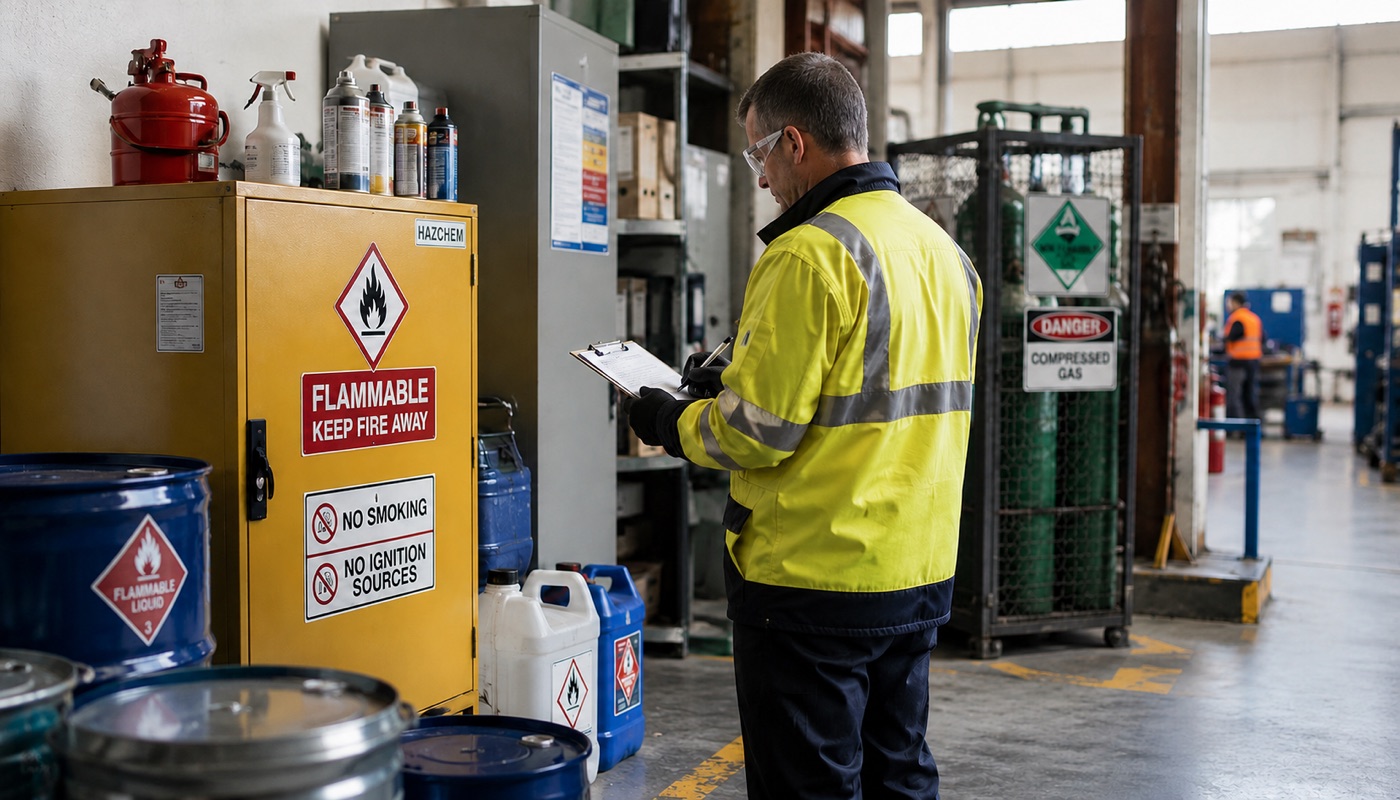
In line with COSHH requirements, chemicals and hazardous substances should be correctly labelled and stored. Always follow the instructions on the material's safety data sheet (SDS).
- Store chemicals and hazardous materials in a designated area.
- Ensure that storage areas are well-ventilated, secure, and situated away from ignition sources and direct sunlight. To maintain safe conditions, confirm that extraction tools and air supplies are working properly.
- Store incompatible chemicals separately at a distance of at least three metres. Acids and alkalis should be kept on separate shelves.
- Store only the minimum required amount of chemicals on-site.
- Use secondary containment measures, such as spill trays or bunds, to prevent leaks and spills from spreading.
- Don't stack materials against air vents or grills.
- Keep substances in their original containers. If you need to decant materials, use suitable, clearly labelled receptacles.
- Label all materials with the substance's name, hazard symbols, handling instructions, and any other relevant information.
Train your team on correct handling techniques
Teaching staff to safely handle hazardous materials prevents accidents, injuries, and harmful exposure. As an employer, it's important to train your team to understand the risks of chemical handling and effectively protect themselves and others. Staff should know how to:
- Read labels and safety data sheets (SDS), interpreting information on hazards, handling instructions, and appropriate control measures.
- Store, handle, and dispose of COSHH materials according to approved procedures and regulatory requirements.
- Correctly use personal protective equipment (PPE), including gloves, goggles, aprons, and respirators, as specified on the SDS or recommended by the risk assessment.
- Check containers for signs of leaks, wear, and damage before every job.
- Maintain correct ventilation to reduce inhalation and exposure risks of fumes, vapours, or dusts. This may include the use of local exhaust ventilation (LEV) systems.
- Minimise spills, splashes, or releases and clear up substances immediately using appropriate methods, such as spill kits, absorbent pads, granules, or mats.
- Refrain from eating, drinking, or smoking in areas where COSHH materials are handled.
- Promptly report incidents and concerns to their supervisor or health and safety officer.

Last updated
March 26, 2024
Opus Safety
Health & safety insights
Guidance, updates and practical advice for your sector.





Do I need a competent person if I have no in-house H&S expert?
Yes. Every UK employer must appoint one under Regulation 7. What happens if you do not, and how to appoint an external consultant.
HSE prosecutions: Counting the cost of non-compliance
Two fall from height prosecutions in one week and a £120,000 dust fine. What recent HSE enforcement action means for your controls.
The psychology of safety: When workarounds become the way we work
Two machinery prosecutions show how shortcuts become standard practice. How to build a safety culture where the safe way is the default way.
Planning new or non-routine work: When the job changes, so do the risks
When work changes location, equipment or method, the risks change too. How to spot the triggers for reassessment and plan non-routine work safely.
Opus Safety partners with Lydia Walmsley Racing for the 2026 season
Opus Safety has joined Lydia Walmsley Racing as a partner for the rest of the 2026 Porsche Carwow Sprint Challenge GB season, starting at Knockhill.
Why Was the Health and Safety at Work Act Introduced?
Why was the Health and Safety at Work Act introduced? The disasters, the Robens Report and the duties the HSWA still places on UK employers today.
What Law Regulates Workplace Health and Safety? DSEAR Explained
What law regulates workplace health and safety? A clear guide to the HSWA, DSEAR and whether your business needs a DSEAR risk assessment.
Hot weather health and safety: six essential questions
Six essential questions to keep your team safe in hot weather – heat stress, hydration, PPE, first aid and driving – with practical steps for summer working.
HSE prosecutions: Workplace fatalities and seven-figure fines
Four recent HSE prosecutions – from a £1m refinery gas leak to fatal and life-changing injuries – and the simple controls that would have prevented them.
Maintain momentum with a mid-year health and safety check
Use the mid-year point to take stock of your health and safety: risk assessments, training, PPM and agency staff. A practical checklist to keep momentum through summer.

Why businesses choose
Opus Safety
We've worked across UK industry for years. The numbers show what our clients achieve when compliance becomes a strength, not a burden.


%201.svg)


